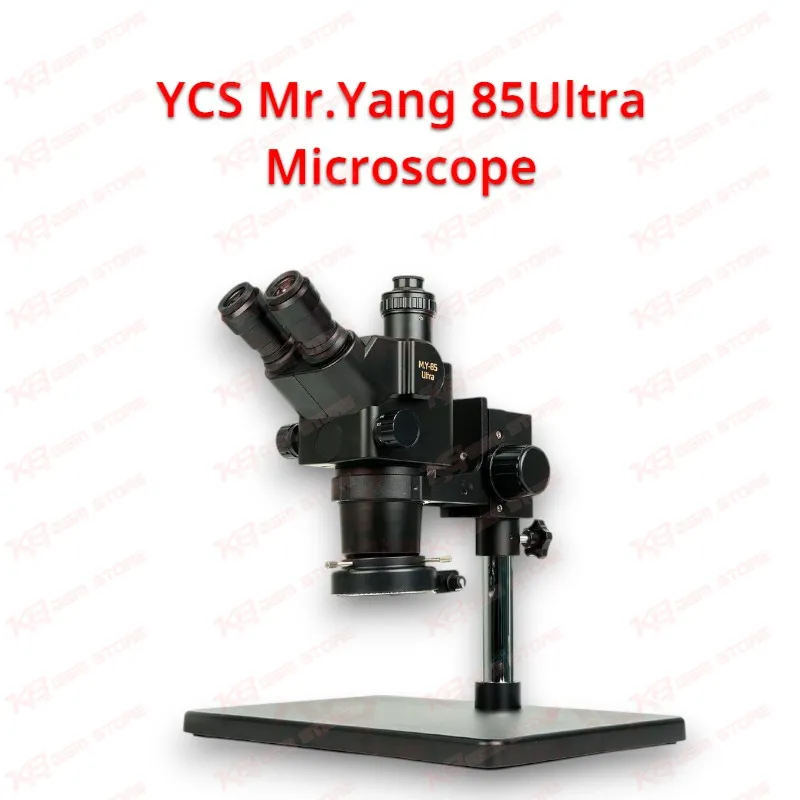
Every board-level repair comes down to one question: can you clearly see what your tools are touching? The YCS Mr.Yang 85Ultra Microscope answers that with a trinocular stereo head and a 6.3X to 68X continuous zoom range, built for mobile phone, laptop, and electronics motherboard work. You get a true stereo image with real depth, which matters when you align a CPU, lift an RF shield, or guide a soldering tip between two capacitors that sit almost touching each other. For technicians who handle dead phone cases, charging issue boards, and network issue faults every day, this microscope turns guesswork into controlled, repeatable bench work.
The continuous zoom covers the full span of a normal repair job without a single lens change. At 6.3X, you see a wide section of the logic board, which helps you locate the fault zone, check for corrosion after water damage, or spot a burnt component near the charging circuit. Turn the zoom knob and the image climbs smoothly toward 68X, where you read tiny IC markings, inspect solder joints around a PMIC, and check BGA ball edges after reballing. Continuous zoom has no fixed steps, so you stop at exactly the magnification your task needs and keep the same area in view while you work.
Two high-eyepoint wide-angle 10X/23 eyepieces come in the standard set. The high eyepoint lets you keep a relaxed distance from the eyepieces, which helps technicians who wear glasses, and the 23mm field shows more of the board in each look. In a busy shop where you sit at the bench for eight or ten hours, that comfort directly affects your accuracy. Less eye strain means steadier hands during jumper wire work, cleaner pad repair, and fewer slips when you route a fine wire across a broken trace. YCS built the body around an ergonomic layout to cut fatigue across long sessions.
The third optical port separates a trinocular model from a basic binocular microscope. The YCS Mr.Yang 85Ultra Microscope ships with a 0.5X CTV adapter, so you can mount a 4K microscope camera on top and send the live image to a monitor. You record repairs as proof for walk-in customers, show a junior technician exactly where to place the tip, or run a live class in a training institute while you keep working through the eyepieces. The camera sells separately, which lets you start with the optical set and add a 4K camera later when your shop needs recording or teaching.
Heat sits close to the optics during every IC change. When you run hot air on CPU underfill, pull a shield, or reflow an eMMC or UFS chip, warm air rises toward the lens. The 85Ultra body tolerates temperatures up to 105°C and uses heat-resistant, wear-resistant materials, so it suits normal rework work right under the head. Keep your hot air nozzle angled at the board rather than straight up toward the objective, and the optics stay clear through years of daily use. That durability matters in workshops where one microscope serves the whole bench from morning to closing time.
The standard set gives you everything for a working bench setup: the main optical unit, main unit bracket, column, limiter, LED light source, microscope base, both eyepieces, and the CTV adapter. The base anchors the column and keeps vibration down, so a bump on the table does not throw your view off mid-solder. The limiter holds the bracket height on the column, which means you can loosen the bracket to swing the head aside and bring it back to the same working position. The LED light source spreads even light across the board, cutting the shadows that hide hairline cracks, lifted pads, and solder bridges under shields.
Inside the repair workflow, the 85Ultra sits at the center of diagnostics and rework. During fault finding, you pair it with a multimeter and a DC power supply to trace a short, then use the microscope to find the exact capacitor or IC that shows damage. For a hang on logo or boot loop issue that points to a hardware fault, you inspect CPU and memory solder joints before deciding on a reball. During IC change work on PMICs, charging ICs, audio ICs, and RF chips, it works next to your hot air station, soldering station, and reballing kit, with a PCB holder keeping the board flat and locked. For dead phone data recovery through ISP pinout, the zoom helps you solder fine wires onto test points without lifting nearby pads.
Getting sharp results takes a short routine. Start every job at low zoom to place the board under the light and center the area you need, then climb the zoom while you fine-tune focus. Working this way keeps you oriented on a crowded board and saves time hunting for a component at full magnification. Clean the eyepieces and objective with a lens cloth instead of a shirt sleeve, since flux smoke and solder fumes leave a film that dulls contrast over time. A fume extractor on the bench protects both your lungs and your optics.
Shop owners who still work under a magnifier lamp get the biggest jump from this upgrade. Board-level jobs you used to send out, such as CPU reballing, FPC connector pin repair, and underfill removal, become possible in your own shop. Service centers get a dependable inspection station for quality checks after repair, and training institutes get a trinocular platform that lets students watch the instructor’s hands on a screen. The upgrade path stays simple: add a 4K microscope camera and monitor first, then an LED ring light if you want shadow-free illumination for ultra-fine work.
When you weigh the YCS Mr.Yang 85Ultra Microscope price in Pakistan against what you pay to outsource reball and IC jobs every month, the numbers favor bringing that work onto your own bench. KB GSM Store stocks it alongside the hot air stations, soldering stations, reballing kits, and PCB holders that complete a professional board repair setup, so you can build your full bench from one place.