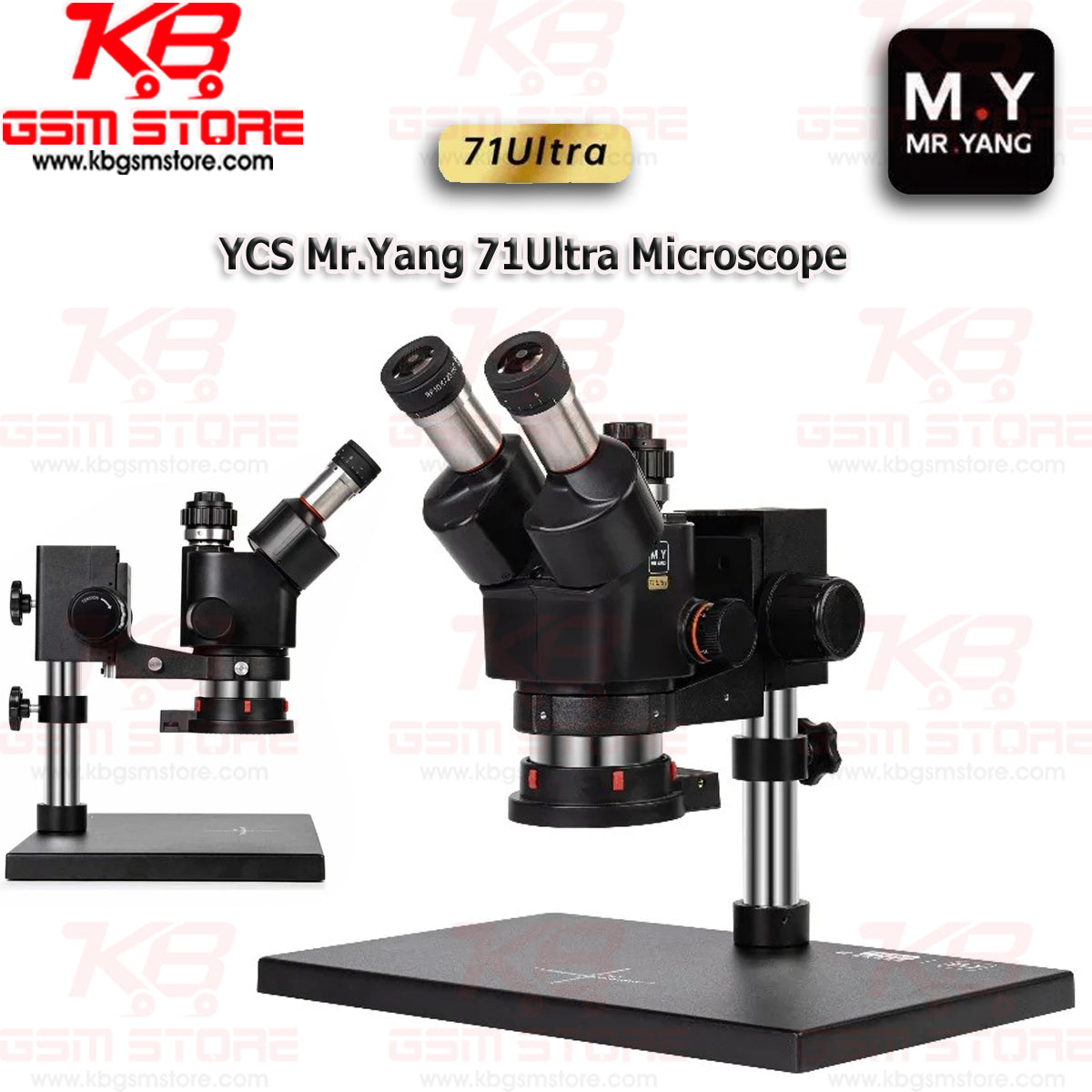
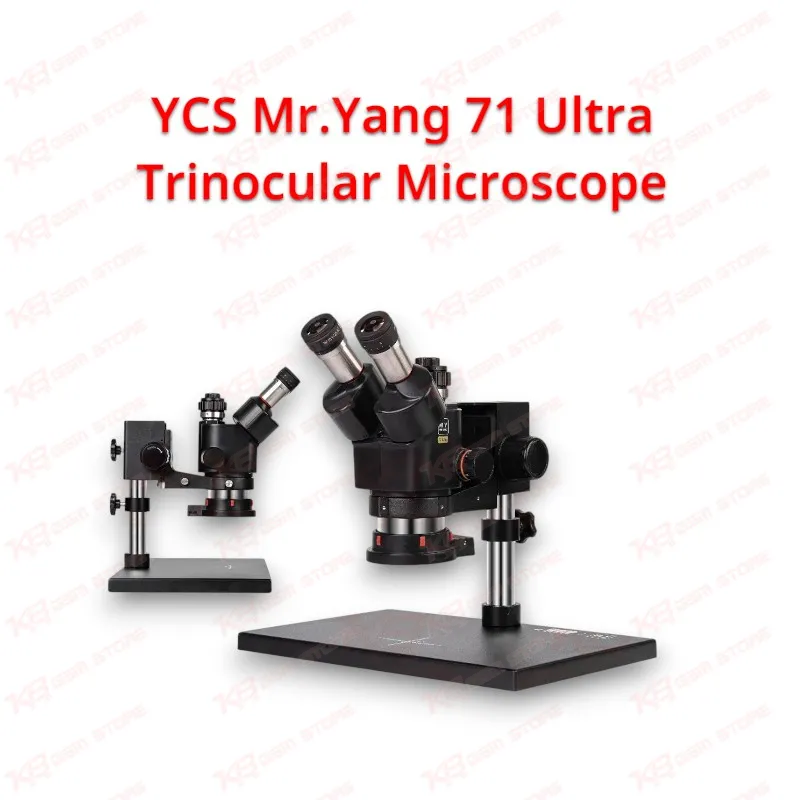
The YCS Mr.Yang 71 Ultra Trinocular Microscope gives your repair bench the optical control that board-level work demands every single day. When a dead phone lands on your counter and the fault sits under a PMIC, around a charging IC, or between two hairline traces near the CPU, your eyes alone cannot tell you what went wrong. This microscope runs a 6.5X to 58X continuous zoom, so you start with a full view of the motherboard, trace the suspect area, and then roll the zoom up until a single pad, a cracked solder joint, or a lifted BGA ball fills your view. You never swap lenses or lose your position on the board, and that saves real minutes on every job. Technicians who handle charging issue complaints, network issue faults, display problem boards, and hang on logo phones all day know how much time disappears when they keep refocusing a cheap stereo head. The 71 Ultra removes that friction and keeps your workflow moving from inspection to repair without interruption. The trinocular head sets this model apart from a basic binocular microscope. You look through the two eyepieces while the third port feeds a camera, so the same image reaches your monitor in real time. The 71 Ultra comes in a bundle option with the YCS X80 4K camera, and the head works with 4K microscope cameras for clear, detailed footage. That matters in a Pakistani repair shop for more reasons than one. You record a before-and-after video of a jumper job and send it to the customer on WhatsApp as proof of work. You show a junior technician exactly where to place the iron tip without both of you bumping heads over the eyepieces. Training institutes run live demonstrations on a large screen so a full class follows a reballing session step by step. Repair channels film clean board-level content straight from the optical path. One microscope covers bench work, customer trust, and teaching at the same time. Comfort decides how long you stay accurate on a busy day, and the YCS Mr.Yang 71 Ultra Trinocular Microscope handles that through its 45-degree tilted observation head. You sit upright, keep your neck in a natural position, and look into the eyepieces without hunching over the board. After eight or ten hours of IC replacement work, that posture difference shows up in your shoulders and in the quality of your soldering. The fixed frame and fixed magnification mechanism add another practical advantage. You lock the zoom at the magnification you trust for a particular task, so you return to the exact same view after you lift your head to grab tweezers, flux, or a replacement chip. When you repeat the same job on a run of identical boards, such as a batch of charging IC swaps on one model, that repeatability keeps your results consistent. A wobbling microscope ruins micro soldering faster than a bad tip. The 71 Ultra stands on a large, sturdy base that reduces vibration from your bench, from a nearby hot air station, and from the movement of your own hands. Durable metal construction keeps the column rigid, so the image stays steady at higher magnification where even small movement turns into a blur. You get a stable platform for long precision sessions rather than a light stand that drifts every time someone leans on the table. For shops that seat several technicians along one long bench, that stability makes a clear difference in daily output. Think about where this microscope sits in a real board-level workflow. You start with diagnostics: you power the board through a DC power supply, check current draw, and then use the YCS Mr.Yang 71 Ultra Trinocular Microscope to hunt for burnt capacitors, corrosion from water damage, or shorts around the power rails. Next comes the repair stage, where you remove an underfilled CPU, clean the pads, and inspect every ball position before you place a new chip. During BGA reballing, the zoom range lets you confirm stencil alignment and check that each ball sits round and even after reflow. For jumper wire work on broken traces, the high end of the zoom shows you the exact copper path, so you solder a clean, short link instead of a messy bridge. Final inspection catches any stray solder ball under a shield or any tiny component you knocked loose during rework, before the phone goes back to the customer and returns with the same fault. This microscope supports software-side technicians more than many people expect. When a phone goes dead after flash and you need ISP access, you have to locate test points and solder fine wires to them. The microscope gives you the clarity to identify those points and attach your ISP pinout wires cleanly, which protects the board from accidental damage. The same applies when you inspect eMMC or UFS chip areas before you lift a memory chip for direct programming. Outside phone repair, the 71 Ultra serves PCB assembly and testing, LCD inspection, IC-level component checks, scientific work, and teaching demonstrations, so electronics workshops and training centers get full value from it too. The microscope works best as the centre of a complete micro soldering station. Pair it with a quality soldering station and a precise hot air station for component removal, a PCB holder that keeps the board flat and secure under the lens, a reballing kit with the right stencils for CPU and memory work, and a digital multimeter for continuity and short checks as you go. When your bench grows and you want sharper recordings or a second display for customers, the upgrade path runs straight to a dedicated 4K microscope camera such as the YCS X80, which mounts on the trinocular port and turns the setup into a full documentation and teaching station. For repair shop owners in Lahore, Karachi, Islamabad, and every growing market in between, the YCS Mr.Yang 71 Ultra Trinocular Microscope offers a serious step up from basic binocular models. You get a wide zoom range that covers both full-board overview and pad-level detail, a trinocular port ready for 4K recording, a comfortable 45-degree head for long shifts, a zoom lock that keeps your working view consistent, and a stable metal frame that holds the image steady. Whether you run a busy service center or set up your first serious hardware bench, this microscope helps you take on CPU, PMIC, and BGA jobs with confidence and finish them with fewer comebacks.