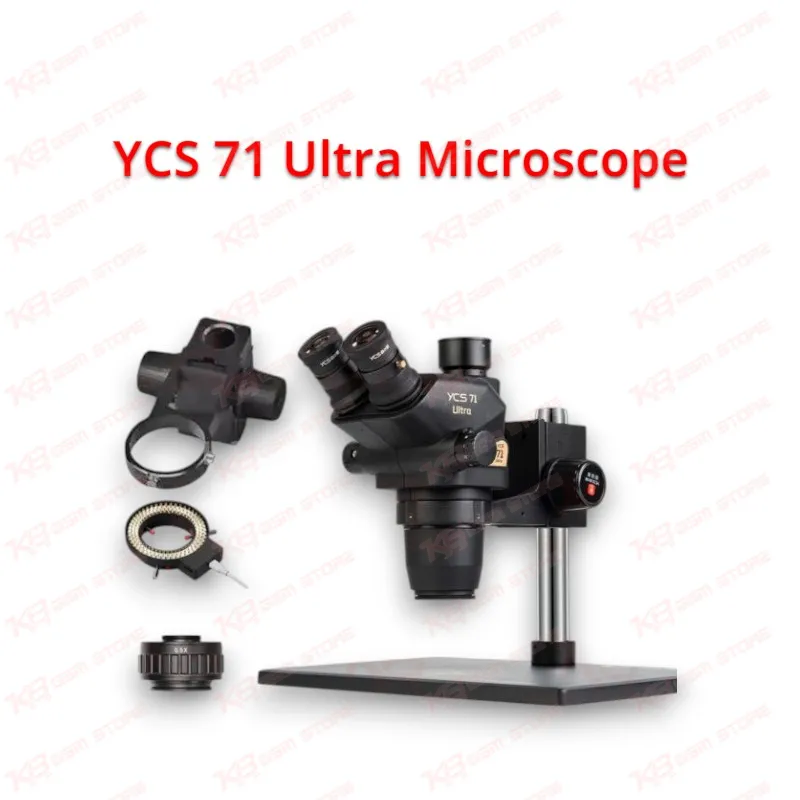
Every board-level job on your repair bench starts with seeing the fault clearly, and the YCS 71 Ultra Microscope gives you that view without eye strain across a full working day. This trinocular stereo microscope runs a 0.67X to 4.5X continuous zoom objective with PL10X/23mm widefield eyepieces, so you move from a full motherboard overview at 6.7X down to a single shorted capacitor at 45X with one turn of the zoom knob. For Pakistani repair shops handling a dead phone, a charging issue, or a phone that hangs on logo after liquid damage, you get a stable optical platform built for real soldering work rather than occasional inspection.
The optical path is the heart of this unit. The zoom body delivers a 6.7:1 zoom ratio, and the image stays sharp as you climb through the magnification range instead of forcing you to refocus at every step. At the low end you see a wide stretch of the PCB, enough to trace a power line from the battery connector to the PMIC area. At the top end you inspect BGA ball rows, cracked joints under a charging IC, and lifted pads after an IC removal. The 23mm field number on the eyepieces widens the visible circle compared with standard 20mm eyepieces, so you spend less time sliding the board around under the lens.
Long hours behind a microscope punish your neck and eyes, and the YCS 71 Ultra addresses that directly. The viewing head tilts the eyepiece tubes at 45 degrees, which keeps your back straight while you work. High eyepoint eyepieces let you keep a comfortable distance from the lens, and technicians who wear glasses still see the full field without pressing their frames against the eyecups. Each eyepiece adjusts across ±5 diopters, so you correct the difference between your left and right eye and get one clean stereo image. The head rotates a full 360 degrees, letting you turn the microscope toward a second technician or reposition it without touching the stand.
Two mechanical details separate the 71 Ultra from budget microscopes on Pakistani repair counters. The fixed-frame design locks the optical body into a rigid structure, so the image holds steady when you press down with tweezers or a soldering iron tip. The magnification limiter lets you lock the maximum and minimum zoom points you actually use. Set a lower stop for general board inspection and an upper stop for micro-soldering, and you jump between them by feel without lifting your eyes from the eyepieces. In a busy shop where you switch jobs all day, that small lock saves real time on every board.
Stereo optics matter more than digital zoom for hands-on work. Each eye receives its own image through a separate optical path, so you get true depth perception and judge exactly how high your tweezers sit above a component and how far a soldering tip travels before it touches the pad. Screen-only digital microscopes flatten that depth, which is why experienced technicians still prefer eyepieces for removing and placing tiny 0201 components, underfilled ICs, and stacked board connectors on modern flagship phones.
The third optical port turns this microscope into a recording and teaching station. The trinocular head accepts most HDMI 4K microscope cameras through a CTV adapter, with the 0.5X CTV lens as the common pairing for this model. Connect a camera and you send a live image to a monitor while you keep working through the eyepieces. Shop owners use this to show a customer the burnt component on their own phone, and training institutes use it to demonstrate jumper wiring to a full class on one screen. You also record before-and-after footage for your shop’s social media or for warranty disputes.
Inside the actual repair workflow, the YCS 71 Ultra sits at the inspection and micro-soldering stages. When a dead phone lands on your bench, you check the board for corrosion, burnt marks, and missing components before you power it from a DC supply. When freeze spray or a thermal camera points you to a shorted line, you zoom in to find the exact capacitor or coil. During IC replacement, you clean pads, check alignment, and confirm every ball sits correctly after reballing. After the job, you scan for solder bridges and stray balls that could create a fresh hardware fault. Running a jumper on a broken trace for a network issue or display problem becomes far more reliable when you watch the wire land exactly on the pad.
Lighting and mounting decide how well any stereo microscope performs. Pair the 71 Ultra with a 144 LED ring lamp, such as the YCS zone lighting ring made for the 71 Ultra series, to get even, shadow-free illumination across the board. Mount the head on a heavy base stand for a fixed bench setup, or on a swing arm when you need a large working area for tablet and laptop boards. Either way, give it a solid surface, because a stable bench removes vibration and keeps the high-magnification image steady.
The YCS 71 Ultra works best alongside the rest of your board repair gear. Browse our Microscopes category for compatible lights, cameras, and stands, and complete the station with a Hot Air Station for IC removal, a Soldering Station for fine pin work, a PCB Holder to keep the board flat under the lens, and a Reballing Kit for BGA chips. A quality Multimeter rounds out your diagnostic side. When your shop moves into heavier CPU-level and stacked-board work, a 6.5X–58X class trinocular microscope makes the natural upgrade path.
For technicians searching for the YCS 71 Ultra Microscope price in Pakistan, KB GSM Store supplies repair shops in Lahore, Karachi, Islamabad, and across the country. You get one microscope that handles daily mobile repair, PCB rework, LCD assembly checks, and IC inspection, with optics that stay comfortable through long shifts and a camera port ready for the day you start recording your work.