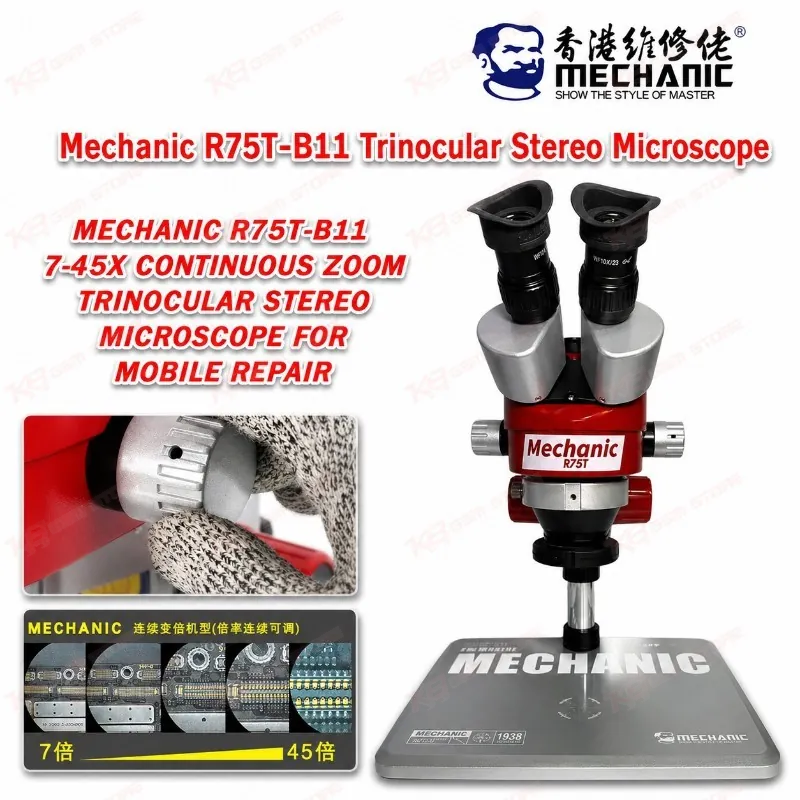
Board-level mobile repair depends on what you can actually see, and the Mechanic R75T-B11 Trinocular Stereo Microscope puts a sharp, three-dimensional view of every pad, solder joint, and micro-component right at your repair bench. Mechanic builds this unit around a 7X–45X continuous zoom system, so a single turn of the zoom control takes you from a wide view of the full logic board down to a close look at one tiny resistor beside the PMIC, without swapping lenses or rebuilding your setup. For a Pakistani repair shop that handles dead phones, charging issues, network issues, and hang-on-logo cases every day, that range covers almost every stage of hardware diagnosis and rework. The stereo design matters more than most buyers realise when they compare options. A stereo microscope sends a separate image to each eye through two optical paths, and your brain merges them into a real sense of depth. That depth perception tells you exactly how high your soldering iron tip sits above a pad, how close your tweezers are to a neighbouring capacitor, and whether a solder ball under a BGA chip has actually melted. A flat screen-based digital microscope cannot give you that spatial judgement, which explains why experienced board-level technicians still rely on stereo optics for delicate jumper work and IC change jobs. The trinocular head adds a third optical port on top of the standard binocular viewing head. You can mount a compatible microscope camera on that port and send the live image to a monitor while you keep working through the eyepieces. Training institutes use this setup to show students every step of a reballing job on a big screen, and repair shop owners use it to record repairs, document board damage, or show a customer the corrosion that killed their phone. The package contains the microscope itself, so you choose the camera and adapter that fit your budget and display setup. Optics on the Mechanic R75T-B11 Trinocular Stereo Microscope start with full optical glass elements and a pair of WF10X/20mm high-eyepoint eyepieces. High-eyepoint eyepieces let you hold your eyes at a comfortable distance from the lens, which helps technicians who wear glasses and cuts fatigue during long sessions. The binocular viewing head sits at a 45° incline, and the interpupillary distance adjusts across 54–76mm, so every technician on a shared bench can set the eyepieces to their own eye spacing in seconds. Accurate alignment between the two optical paths keeps the merged image comfortable, and that matters when you spend three hours tracing a short circuit across a stacked iPhone board. Working distance decides how comfortable your rework actually feels. This model gives you an effective working distance of 100mm between the objective and the board, which leaves enough room to bring in a hot air nozzle, a soldering iron, and a pair of fine tweezers at the same time. If your work needs more clearance or a different magnification range, optional auxiliary objective lenses extend the working distance anywhere across the 26mm–287mm range, depending on the lens you fit. The focusing bracket offers a 50mm lifting range, so you can raise the head to clear tall components, PCB holders, or thick fixtures and then drop it back into focus quickly. The B11 base pairs with a sturdy all-metal pillar stand. A rigid pillar keeps the optical head steady, and steadiness at 45X separates a usable image from a shaking blur every time someone bumps the bench. Metal construction also handles the daily heat and handling of a busy repair counter far better than lightweight plastic stands. Now consider where this microscope fits inside a real repair workflow. Diagnosis comes first: after your multimeter or DC power supply points you to a shorted line, you scan that area under magnification to find the burnt capacitor, cracked component, or lifted pad behind the fault. On water-damaged phones, the zoom reveals green corrosion under shields and between connector pins that the naked eye simply misses. During IC change work on charging ICs, audio ICs, PMICs, or network ICs, you watch the solder melt under hot air, lift the chip cleanly, inspect the pads for damage, and confirm alignment of the new chip before reflow. For CPU and memory reballing, you check stencil alignment and ball quality before you seat the chip back on the board, and a clear view here directly lowers the chance of a phone that stays dead after the job. Jumper work depends heavily on magnification as well. When a trace breaks or a pad rips during removal, you solder thin jumper wire from a test point to the correct component, and the stereo view lets you route that wire cleanly without touching nearby parts. Software technicians benefit too: ISP work on dead phones and boot loop cases means soldering fine wires to tiny ISP pinout points before you connect eMMC programmers or UFS adapters for data recovery or direct flashing. Without proper magnification, one slip bridges two points and turns a recoverable board into scrap. After every repair, a final inspection pass under the microscope catches solder bridges, missing components, and flux residue before you close the phone and hand it back. This microscope also sits at a logical upgrade point in a technician's tool journey. Many shops start with a magnifier lamp or a basic USB microscope, then hit a wall when board density and component size move past what those tools can show. Stepping up to a 7X–45X stereo zoom microscope opens the door to confident micro-soldering, CPU reballing, and advanced board repair, the high-value jobs that separate a full repair centre from a screen-and-battery counter. Pair it with a quality hot air station, a temperature-controlled soldering station, reballing kits, and a reliable PCB holder, and your bench covers the complete rework cycle from diagnosis to final testing. Add multimeters and test boxes for the electrical and software side, and the microscope becomes the visual centre that ties the whole workflow together. Technicians who open Samsung, Oppo, Vivo, Infinix, Tecno, Xiaomi, and iPhone boards all face the same challenge: components keep shrinking while board layers keep stacking. A dependable stereo zoom microscope keeps your eyes ahead of that trend. If you run a busy repair shop, a mobile service centre, or a training institute anywhere in Pakistan, the Mechanic R75T-B11 gives you trinocular flexibility, continuous zoom, generous working space, and a solid metal stand in one practical package, and KB GSM Store supplies it ready for your workbench.