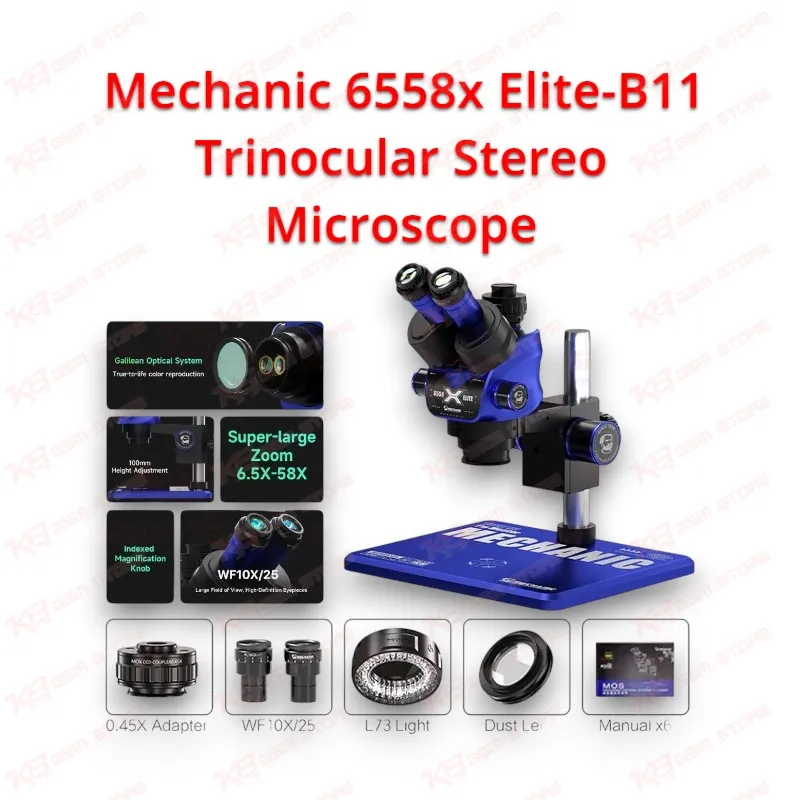
The Mechanic 6558x Elite-B11 Trinocular Stereo Microscope puts a 6.5X to 58X continuous zoom range on your repair bench, and that range changes how you approach a modern smartphone motherboard. At 6.5X you get a 38mm field of view, wide enough to scan a full section of a Samsung, iPhone, Oppo, Vivo, Infinix, or Tecno logic board and spot a burnt capacitor, a lifted pad, or corrosion around the charging circuit within seconds. Turn the single zoom knob and the image tightens to 58X with a 4.3mm field, where you read the markings on a PMIC, inspect a cracked joint at the edge of a CPU, or check whether a tiny passive component sits square on its pads. You never swap lenses and you never lose your place on the board, because the objective zooms continuously from 0.65X to 5.8X with an 8.9:1 zoom ratio. For a technician facing a dead phone, a short on the main power line, or a boot loop issue caused by a weak BGA joint, this continuity saves real time: you locate the fault at low magnification, zoom in to confirm it, and start the repair without breaking concentration. The optical design focuses on comfort during long workshop hours. Mechanic fits the head with WF10X/25mm wide-field eyepieces and specifies near-zero distortion, generous depth of field, and an erect, true-colored image, a combination that reduces eye strain when you spend an entire afternoon on micro soldering. The 25mm field number gives you a broader viewing circle, so you reposition the board less often and keep your orientation as you trace a line from the charging IC toward the battery connector or follow a track into the network section. Both eyepieces carry their own diopter adjustment, which lets you correct the difference between your left and right eye, and the interpupillary distance adjusts from 54mm to 76mm so the stereo image merges properly for nearly every user in the shop. The head sits at a 45° inclination and rotates through a full 360°, so two technicians on opposite sides of a bench can share one unit, or you can turn the head when your soldering hand needs a different angle. Depth perception is the real reason a stereo microscope outperforms a single-lens USB camera for board-level rework. Each eye receives a slightly different image, and your brain converts that into height information: you see whether your tweezers touch the top of a component or the board beside it, whether the solder balls under an IC have collapsed evenly, and how far your iron tip sits above a delicate trace. That three-dimensional view makes jumper work far safer. When a track breaks near the CPU, the display connector, or the RF section and you need to run a jumper, you see the enamel wire, the exposed pad, and the iron tip in true depth, so you avoid tearing neighboring pads or bridging two lines. The same advantage applies to every IC change job on charging ICs, audio ICs, power management chips, and backlight ICs, where a slight misalignment during placement creates a fresh short or an open joint that brings the phone straight back to your counter. The 100mm working distance gives you physical room to work under the lens. You fit a hot air nozzle, a soldering iron, and tweezers below the objective at the same time, and you keep a PCB holder or fixture on the base without striking the optics. That clearance matters during underfill removal, BGA reballing, charging port replacement, and FPC connector rework, where tools approach the board from several angles at once. It also keeps the objective further away from the heat when you run a hot air station on a stubborn shield or a glued CPU. The B11 base completes the Elite-B11 configuration. Mechanic pairs this head with its B11 pillar-type large flat base, which provides a solid column mount and a wide platform for boards, fixtures, and holders. A heavy, wide base reduces wobble at 58X, where even a small bench vibration visibly shifts the image, and Mechanic designs the head to work with other bases in its base series if you want to adapt the setup later. The trinocular design adds a third optical port beside the two eyepiece tubes. That port accepts a microscope camera, which lets you show the board on a monitor, train junior technicians on live repairs, show a customer the exact corroded area or damaged IC on their own phone, and record repair videos for your shop's online presence; confirm the package contents at purchase and pair the head with a compatible camera and light source to use this port fully. Inside a typical repair workflow, the microscope sits at the center of diagnosis and rework. You start with a multimeter, a DC power supply, or a test box to identify the faulty line, then move the board under the microscope to find the shorted capacitor, the cracked joint, or the damaged chip. From there you reach for a hot air station for component removal, a soldering station for pad cleaning and tinning, a reballing kit with stencils for BGA chips, and a PCB holder that keeps the board flat and secure. Software-side technicians gain just as much: when a phone goes dead after flash or hangs on logo and you need direct memory access, you solder fine wires onto test points for ISP pinout tools, eMMC programmers, and UFS adapters, and that work demands the clean stereo view and stable magnification this microscope provides. Many shops start with a basic binocular head or a digital USB microscope and move to a trinocular stereo model once board-level jobs become a daily part of the business, and the 6.5X to 58X range covers both quick visual inspection and the finest micro soldering without an extra objective. Repair shop owners, mobile service centers, hardware engineers, and technical training institutes all benefit from this setup, especially where several technicians share one bench or where instructors need to display work on a screen. KB GSM Store supplies the Mechanic 6558x Elite-B11 Trinocular Stereo Microscope to technicians across Pakistan, including Lahore, Karachi, and Islamabad, so you can upgrade your repair bench with a microscope built for the board-level work your customers bring in every day.